
A caregiver’s story of love and the long road of recovery.
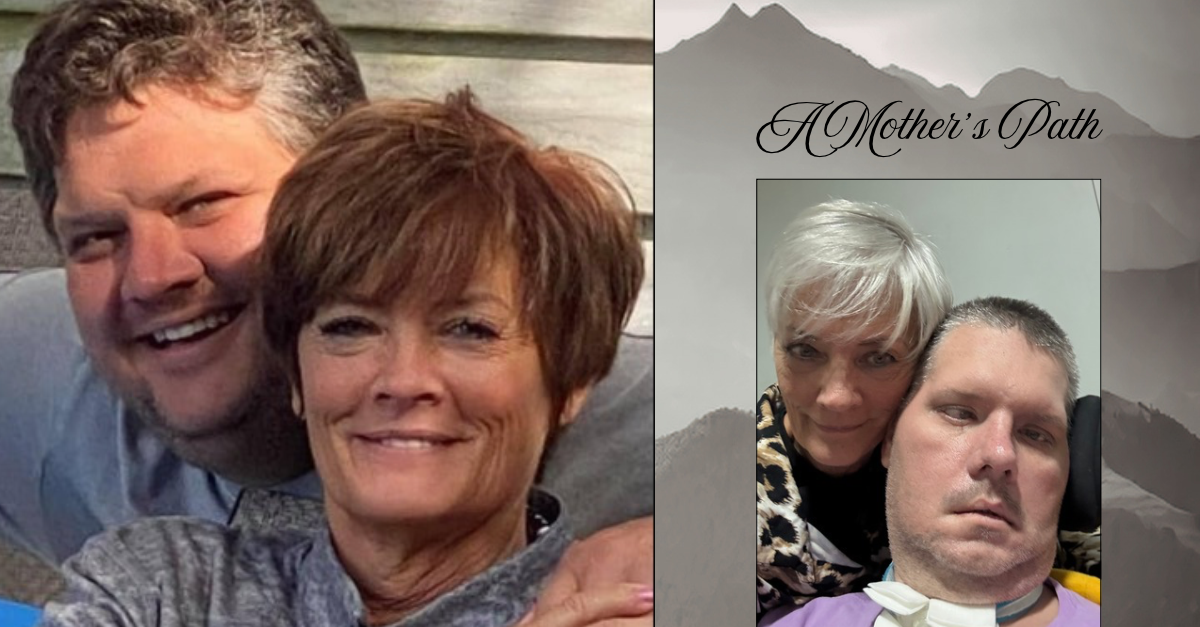
Raine & Tyndall
Some say a mother is only as happy as her saddest child.
That statement has always rung true to me; for a long time, happiness was simple. My son and my daughter were both productive, thriving adults. They had found their people, built their paths, and were living their best lives.
Watching them flourish gave me a deep, settled peace. We were happy. The three of us have always been extraordinarily close.
Every single weekday morning on his way to work, Tyndall would call me. I made a point to set my alarm every day just so I wouldn’t miss those twenty minutes with him. It was, without a doubt, the absolute best way to start my morning. So many times, he would three-way his sister in on the call. We’d laugh, tell jokes, and he’d try to stump us guessing who was singing whatever song came on his radio. Just pure joy, starting the day with two of my favorite people in the whole world.
Then came the morning everything changed.
On September 4th, 2021, in a single moment, my world split down the middle into a before and an after. My son had suffered a life-altering pontine stroke. The life he knew, and the peace our family shared, was broken, and he was fighting just to survive.
The doctors had told us to prepare for the end—to make funeral arrangements, to discuss pulling the plug so he could become an organ donor. But we held our ground. And then, on that third day, came the tiny spark that proved his spirit was still fighting inside a quiet body: he opened his eyes, stared straight at the ceiling for fifteen surreal seconds, and closed them again. He slipped back into the coma for seven more days, but those fifteen seconds were all the answer we needed. He was in there, and we weren't going anywhere.
September 20th, 2021, on his 38th birthday, he received some gifts that were not on any of our lists - a tracheostomy and a feeding tube, as he remained tethered to the ventilator that kept him breathing.
By October 10th, the moment we had prayed for arrived: he was fully awake and finally off the ventilator. Yet waking up brought its own heartbreaking reality. The illness had stripped his body of everything. He could not speak. He could not move his arms or legs. He was too weak to even lift his head from the pillow. But he was alive, and the fight was shifting to a new front.
On October 15th, 2021, the decision was made to transfer him to the Shepherd Center in Atlanta, Georgia. By then, the only physical movement he had regained in his entire body was a subtle flick of his right thumb.
I packed up my life, walked away from my home, left my job, and stepped away from the rest of my family. The day Tyndall was taken into the Shepherd Center on a stretcher, his world had shrunk to the micro-movements of a body forced into total surrender.
But Tyndall was built differently. At 6'3" and 300 pounds, a man who could bench press 450 pounds, a former college football player, and a high school baseball powerhouse, he possessed a foundation forged in sweat, double-session practices, and relentless athletic discipline.
Stroke or no stroke, that drive didn't just disappear. He took the same grit that carried him through grueling two-a-days and channeled it into every single second of rehabilitation. He was always asking for extra physical therapy. Whenever another patient was sick or couldn't make their appointment, the staff would come to his room in the afternoons to get him, and Tyndall gladly, willingly went right back to work.
The progress was a daily testament to human willpower. It started at the absolute bottom, fighting just to twitch a single thumb. Then came moving his hands. Then lifting his head. Then the grueling effort of pushing himself up on his elbows from his stomach, sitting up, and finally pulling his massive frame into a standing position to march in place.
His vision was severely limited—no peripheral vision, unable to see far ahead—and his balance was deeply shaken, but he refused to yield.
Day by day, between October 15th and January 7th, he reclaimed piece after piece of himself. He re-learned how to talk. He re-learned how to eat. He re-learned how to write.
This was during COVID, and the strict safety restrictions meant no visitors were allowed. It was just Tyndall and me, isolated from everything and everyone we knew. Anyone who wanted to see us had to stand outside on the other side of a security fence. Tyndall’s sister drove eight hours to Atlanta just to look at us through those wire links.
I remember walking out to see her, feeling the weight of the distance and the reality of the world we had been cut off from. My heart physically ached for my daughter. A voice on the phone could never replace hugging her, or just sitting in the same room together.
I longed for my three little dogs, left behind in the care of someone else, wondering if they understood why I was gone.
I missed my friends, my routine, and the warm, familiar rhythm of my active life back home.
In that hospital room, stripped of everything else, all I had was Tyndall, and all he had was me. Together, in the quiet spaces between therapies, we carried the shared grief of the former lives we had left behind.
By the time he transitioned to outpatient care, the focus shifted to walking. The momentum was tangible, infectious, and full of undeniable hope. He was on the road back. He could pull himself up to stand and march in place while holding onto a walker, balance still shaky, but winning. He could transfer himself from his wheelchair to the couch. He could haul himself into the truck.
He was going to make it.
Then came the referral.
His Shepherd Center doctor recommended he see a neurosurgeon, and in that single moment, the entire trajectory of his recovery vanished, taking a sudden and tragic turn for the worse.
February 3rd, 2022. Brain surgery. A week in a coma. Another week in an induced coma.
When he opened his eyes this time, he was trapped.
Locked In.
The last word he had ever spoken was that little nickname he called me. The last meal he had ever tasted was a home-cooked meal I made. And now, he couldn't lift a finger. He couldn't even move his thumb. His mind was entirely there—sharp, aware, feeling everything—trapped inside a vault that wouldn't open. He was simply alive, fully present, but completely locked in.
A nursing home was never an option. Not for a single second. But nothing—no class, no pamphlet, no quick hospital brief—prepares you for the sheer, suffocating enormity of what it actually means to bring a person with locked-in syndrome through your front door.
Caregiving at this level is a relentless exhaustion. It is the hardest thing I have ever done. It breaks my heart every single day. But he was home. He was in my care and every ounce of strength I had left belonged to him.
The world outside our walls has shrunk to the width of a hallway, the rhythm of a schedule, and the quiet spaces in between.
Since July 2022, when Tyndall came home, my life has been defined by a single, unwavering devotion. I am his caregiver, his anchor, his advocate, and his voice.
Our days revolve around the grind of recovery. Twice a week, we travel to NextStep for two exhausting hours of physical therapy, then he meets with Dr. Hightower for neuro acupuncture to awaken the silent pathways in his brain. When I bring him home, he is drained, every ounce of his energy spent on the battle to reclaim his body.
But even in that bone-deep weariness, I see it: the fierce, quiet determination in his eyes.
He is fighting, so I fight alongside him.
Yet, love in one direction has meant an ache in another. Just months after Tyndall came home, my daughter gave birth to twin girls. She was a brand-new mother, recovering from a C-section, suddenly responsible for two tiny lives at once. The cruel geography of caregiving kept me from being by her side the way a mother should be. I couldn't be there to take the night shift, to hold her while she healed, or to wrap her in the comfort she deserved. It robbed her of the mother she needed in that moment, and it robbed my granddaughters of the grandmother who envisioned spending endless afternoons watching them grow.
Now, my daughter has three little ones. Every Saturday, religiously, my daughter brings them to see us. The girls adore their uncle—to them, he has always been like this. They don't know the man who was once the vibrant, go-to uncle for every child in the neighborhood. They only know the uncle who loves them with his eyes, his presence, and his quiet spirit.
And so, we keep going. Because beneath the exhaustion and the sacrifice, there is hope.
Tyndall is not paralyzed; his brain simply lacks command, a language his body is relearning word by tiny word.
When this journey began, he couldn't even hold his head up. Today, he holds it high. He went from barely twitching a thumb to moving his whole arm, forming a fist, and reclaiming control of his facial muscles so his mouth no longer gapes open.
Every milestone is slow—excruciatingly slow to an outside world that measures time in days rather than inches—but to us, those microscopic victories are monumental.
We live for those moments. We pray, we celebrate, and we look toward the day he will eat on his own again, and the day his voice will return to fill the quiet room.
But for now, I find myself caught between heartache and hope.